
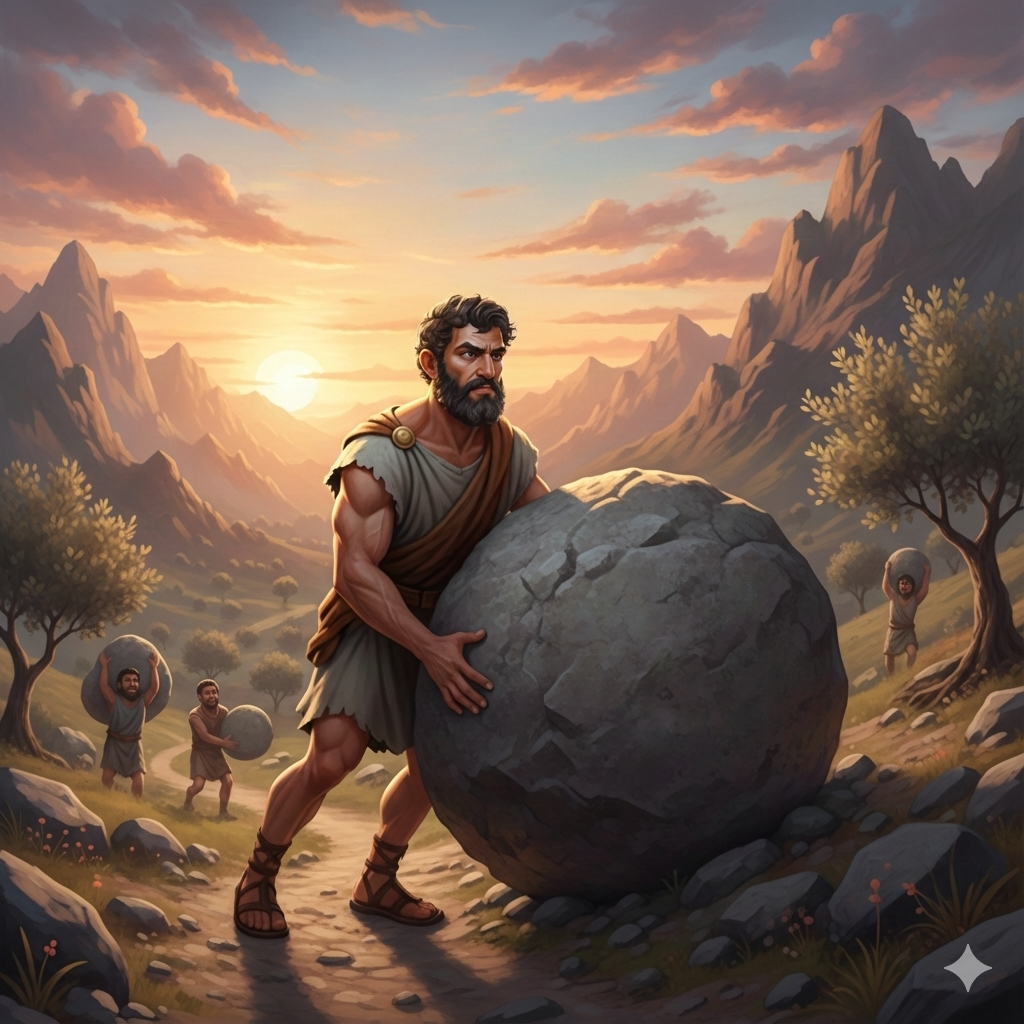
Camus ends The Myth of Sisyphus with a line that unsettles people more than it reassures them; “We must imagine Sisyphus happy.”
It sounds like a trick. A platitude. A way of pretending that suffering isn’t real.
I don’t think that’s what Camus meant at all.
Sisyphus is not redeemed. His task is not justified. The rock does not become meaningful. There is no lesson at the top of the hill, no cosmic wink that makes it all worthwhile. The punishment is exactly what it appears to be: endless, repetitive, and pointless. That is the whole point.
And so is the response.
Life, as I see it, is much the same. It is a mission in the most stripped-down sense: something you are doing until you are no longer doing it. You wake up, you carry the weight of being alive, you push forward, you sleep, and you do it again. Ending it early, as Camus argued, is not a solution, it is a resignation. Not a moral failure, but a surrender to the demand that life justify itself before we agree to live it.
I don’t make that demand.
The universe does not owe me meaning, and I do not need it to provide one. The repetition, the mundanity, the sheer eternity of continuing, none of that is a flaw to be explained away. It is the condition of being alive. Once that is seen clearly, without fantasy or false hope, something unexpected happens.
The absurd stops being an enemy.
Imagining Sisyphus happy is not about lying to ourselves or pretending the task is noble. It’s about recognising that once the illusion of purpose is gone, there is nothing left that can force despair on us. The rock doesn’t get lighter, but it no longer insults us by pretending it was meant to be light. The struggle becomes honest.
I imagine myself happy, and I am happy. Not because life makes sense, but because it doesn’t have to. There is a strange joy in motion without justification. In putting one foot in front of the other not because it leads somewhere, but because walking is what living does.
This isn’t optimism. It isn’t hope. It’s not faith in a future resolution. It’s clarity, followed by endurance.
The gods can keep their punishments. I’ll keep pushing the rock, and I’ll do it with my eyes open.